

Agricultural Economics
Purdue’s Agricultural Economics Department covers a wide array of issues from development, trade, macroeconomics policy implications, agribusiness, production and consumption all the way to environmental and resource issues. Here in Ag Econ, we pride ourselves in our top-notch research, quality teaching and committed Extension. We also house some outstanding centers: the Global Trade Analysis Project (GTAP), the Center for Food and Agricultural Business (CAB), the Center for Commercial Agriculture (CCA) and many more.
CONTACT US
Agricultural Economics
agecon1@purdue.edu
403 Mitch Daniels Blvd.
West Lafayette, IN 47907
(765) 494-4191

Students in Purdue's Department of Agricultural Economics have a 100% placement rate after graduation.

Purdue is home to the #3 agriculture program in the U.S. and #6 in the world.

Students in Purdue's Agricultural Economics undergraduate program have an average starting salary of $58,485.
Students in Purdue's Department of Agricultural Economics have a 100% placement rate after graduation.
Purdue is home to the #3 agriculture program in the U.S. and #6 in the world.
QS World University Rankings, 2025
Students in Purdue's Agricultural Economics undergraduate program have an average starting salary of $58,485.
WHAT CAN I STUDY IN AGRICULTURAL ECONOMICS?
View our majors and degree options
Student Success is our goal
Student Success is our goal

Andy Oppy and Jo Thomas, Department of Agricultural Economics Advisors, were selected by the National Academic Advising Association (NACADA), the Global Community for Academic Advising to receive prestigious annual awards. Andy received...
Read MoreWhat's Trending
Featured Stories

For Brody Cox, preparing for the Indiana State Fair began long before he entered the show...

In the September Purdue University/CME Group Ag Economy Barometer survey, 52% of respondents...

Purdue University’s College of Agriculture recognized nine alumni at the Distinguished...

In 1951, Purdue University faculty members traveled more than 4,000 miles from West Lafayette,...
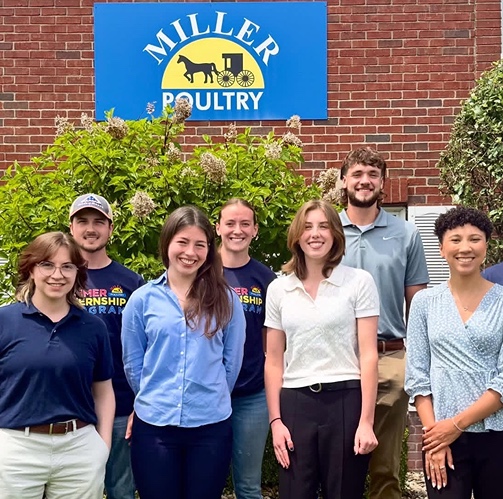
At Miller Poultry, a broiler production company located in Northern Indiana, Purdue Agriculture...

It wasn’t until she was actually in a veterinary hospital, attempting to give an injection...